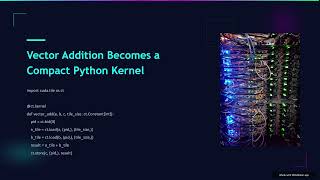
Background to Cuda Python 1 0 Gpu Kernels Without C
Looking for the latest information on Cuda Python 1 0 Gpu Kernels Without C? We've researched comprehensive data, records, and insights about Cuda Python 1 0 Gpu Kernels Without C.
Important Facts
Explore the primary sources for Cuda Python 1 0 Gpu Kernels Without C.
Recent Updates
Stay updated on Cuda Python 1 0 Gpu Kernels Without C's newest achievements.
CUDA Programming Course – High-Performance Computing with GPUs
Lecture 1 How to profile CUDA kernels in PyTorch
Python on NVIDIA CUDA | GPU Acceleration Basics 00
Boost Python Code Speed with GPUs: Compare CPU, JIT, and CUDA
CUDACast #10a - Your First CUDA Python Program
Tutorial: CUDA programming in Python with numba and cupy
Learn GPU Parallel Programming - Introduction to Kernels
7. How to Install Python, CUDA & PyTorch for GPU | Install NVIDIA CUDA, cuDNN, PyTorch & Test GPU
CUDA GPU Programming | Lesson 01 | Writing Your First CUDA Kernel in Python | in Hindi/Urdu
Writing Code That Runs FAST on a GPU
Learn to Use a CUDA GPU to Dramatically Speed Up Code In Python
Deep Dive
Data is compiled from public records and verified media reports.
Last Updated: October 15, 2026
Summary
For 2026, Cuda Python 1 0 Gpu Kernels Without C remains one of the most searched-for information profiles. Check back for the latest updates.
Disclaimer: Disclaimer: All information is compiled from publicly available data, media reports, and analysis. Actual details may vary.
Summary
In this video, I will guide you through the steps to set up If you have any questions you can or dm on twitter or Slides: docs.google.com/presentation/d/110dnMW94LX1ySWxu9La17AVUxjgSaQDLOotFC3BZZD4/edit?usp=sharing ... See how to dramatically speed up In this CUDACast video, we'll see how to write and run your first In this tutorial, I will explain the basics of what the term The LangChain 10 Days FREE Bootcamp is live: 10 lessons, free AI models only, from your first API call to a production grade ... In this video, we talk about how why I explain the ending of exponential computing power growth and the rise of application-specific hardware